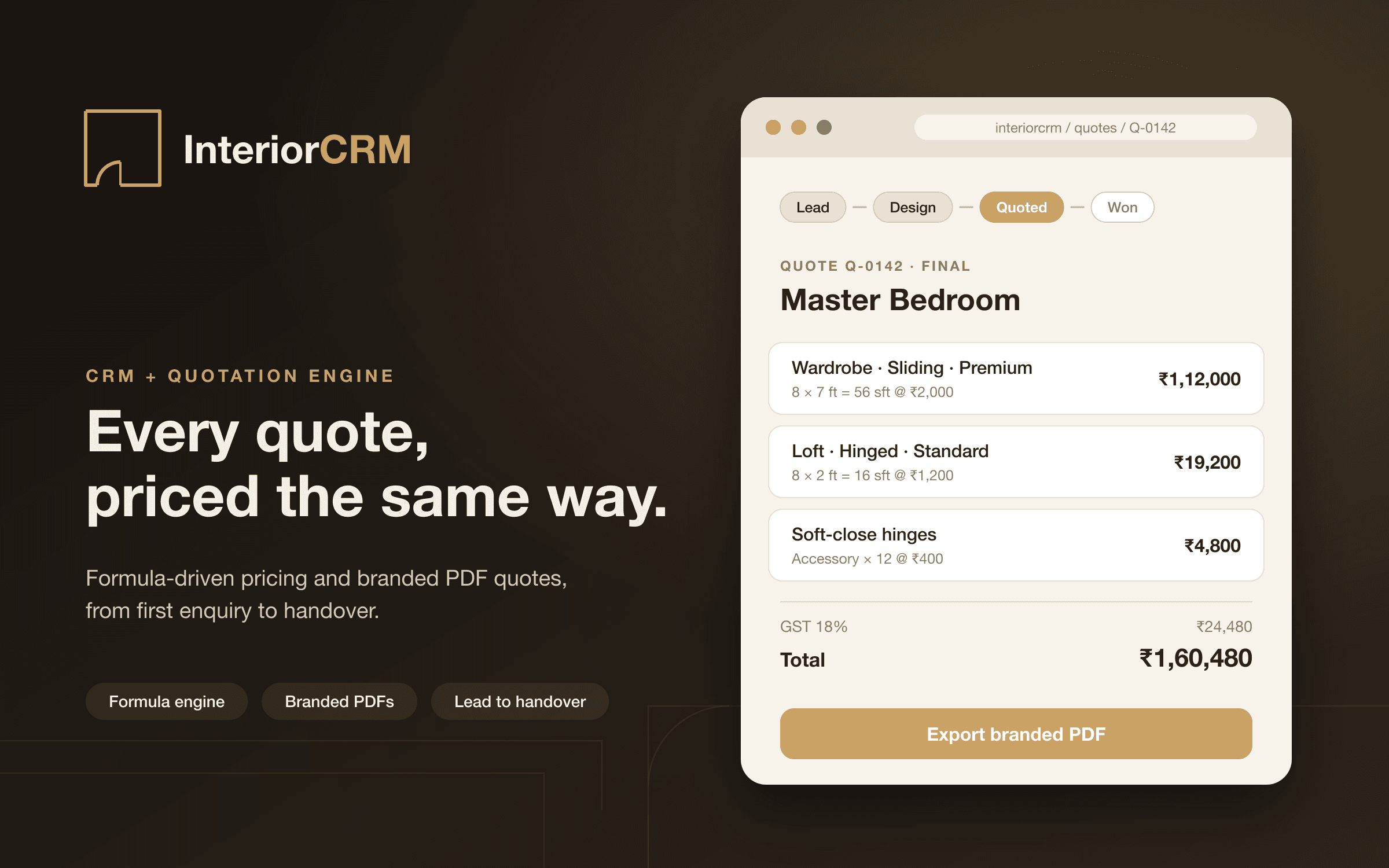
A quote is a hundred small decisions
For an interior and modular-furniture studio, a single quotation depends on the room, the category, the sub-type, the material grade, the dimensions, the hardware and the accessories - and on the price of every one of those on the day it was quoted. The studio needed quoting that every designer did the same way, pricing the studio could change without a developer, and quotes that looked like the studio's own work.
What we built
A pipeline from first enquiry to handover. Every project holds the client, the property and the scope, and moves through the studio's real stages: lead, design, quoted, won or lost, in production, complete. Teammates can be added to a project as collaborators.
Quotes built room by room. A quote is organised into rooms, each with its own line items. Common rooms - a standard foyer, say - can be saved as templates and dropped into a new quote in one step. Quotes move from draft to tentative to final.
A pricing formula engine the studio controls. How much material a line item bills for is set per sub-type: area from width and height, area from width and depth, running length, a fixed quantity, or a custom expression for anything unusual - each with its own rounding rule. Custom formulas are evaluated safely rather than executed as code, so the studio can add new pricing rules from the admin panel without a developer.
Rate cards, grades and specifications as data. Prices are set for every category, sub-type and grade combination. Structure and finish materials, hardware, accessories and spec-sheet text all live in the database and are edited from the admin panel - nothing about pricing is hardcoded.
Branded PDF quotations. Every quote exports as a PDF in the studio's own branding - logo, colours, font, contact and bank details - with its exclusions, material specifications, terms and payment milestones. Rebranding happens in settings and applies instantly to the app and every PDF, with no redeploy. Quotes can be emailed to the client directly from the app.
Two roles. Admins manage the catalogue, pricing, formulas, branding and terms. Designers build quotes but cannot change prices.
The decisions that mattered
Pricing is data, not code. Categories, formulas, rate cards, spec text, accessories, terms and payment schedules are all records the studio edits. The day the studio adds a new product line, nobody has to ship a release.
Line items are snapshotted. When an item is added to a quote, its price and spec text are copied onto the quote. Changing the rate card next month never silently rewrites a quote a client already has.
Money uses decimal arithmetic. Every price and total is computed with exact decimals rather than floating-point numbers, so a quote never drifts by a rupee between the screen and the PDF.
One container, on purpose. The application and its PostgreSQL database ship together in a single image that migrates and seeds itself on boot - a deliberate simplicity trade-off for a single-studio tool, with a persistent volume for the data.
Under the hood
Next.js (App Router, TypeScript) for frontend and backend, PostgreSQL through Prisma, credential sign-in with role-based access, and PDF generation with embedded fonts so the rupee symbol renders correctly. The codebase is covered by more than 200 automated tests across pricing, formulas, quotes, projects, permissions and email.
Outcome
- Consistent quotes across the team - every designer prices from the same rate cards and formulas.
- Pricing changes without a developer - new formulas, rates and grades are added from the admin panel.
- Quotes that don't move - once a line is on a quote, its price is fixed.
- Branded output with zero design work per quote.