
💡 Introduction
The startup landscape in 2025 has fundamentally shifted. With global venture funding becoming more selective and customer expectations reaching new heights, launching a product without proper validation is no longer viable. Minimum Viable Product (MVP) development has evolved from a Silicon Valley buzzword to an essential survival strategy for startups worldwide.
Recent data from CB Insights reveals that 42% of startups fail because they build products nobody wants. This stark reality makes MVP development not just important-it's critical for survival. In 2025, successful startups are those that master the art of building less to learn more, testing assumptions before committing resources, and iterating based on real user feedback rather than founder intuition.
The global MVP development market, valued at $1.8 billion in 2024, is projected to reach $3.2 billion by 2030, driven by increasing startup activity across emerging markets including India, Southeast Asia, and Latin America. This growth reflects a fundamental shift in how entrepreneurs approach product development—from perfectionist tendencies to validation-first methodologies.
This comprehensive guide provides everything modern startups need to know about MVP development in 2025, from initial concept to successful scaling. Whether you're a first-time founder in Mumbai or a serial entrepreneur in Silicon Valley, these proven strategies will help you build products that customers actually want.
🧩 Understanding MVP Development in 2025
What Makes MVP Development Different Today
MVP development for startups in 2025 operates in a dramatically different environment than five years ago. The convergence of AI tools, no-code platforms, and cloud infrastructure has democratized product development while simultaneously raising user expectations.
Modern MVPs must balance minimal functionality with sophisticated user experience. Users in 2025 expect seamless interfaces, instant loading times, and intuitive navigation-even from early-stage products. This creates a unique challenge: delivering simplicity without appearing amateur.
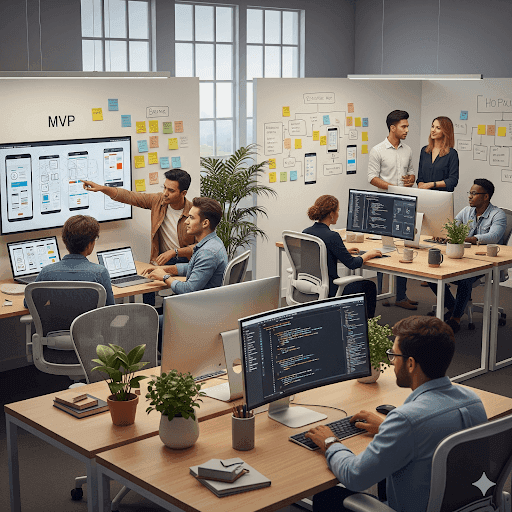
The definition of "viable" has also evolved. Today's MVPs require:
-
Mobile-first design as 68% of users access new products via smartphones
-
Data privacy compliance meeting GDPR, CCPA, and regional regulations
-
API-ready architecture for future integrations
-
Performance optimization with sub-3-second loading times
-
Accessibility features supporting diverse user needs
The Strategic Value of MVP Development
Smart startups use MVP development as a risk mitigation tool rather than just a product launch strategy. The MVP development process serves multiple strategic purposes:
Market Validation: Testing whether your solution addresses a real problem people will pay to solve. Spotify's initial MVP only streamed music-no playlists, no social features, no mobile app. This focus proved streaming demand before building complex features.
Resource Optimization: Preventing the average startup waste of $2.8 million on unnecessary features. Buffer's MVP was literally just a landing page testing demand for social media scheduling-no actual product existed initially.
Team Learning: Building organizational knowledge about user behavior, technical challenges, and market dynamics. Each MVP iteration teaches lessons impossible to learn through planning alone.
Investor Attraction: Demonstrating traction with real users and usage data. Investors in 2025 prioritize evidence over ideas, making successful MVPs powerful fundraising tools.
🎯 The Complete MVP Development Process
Phase 1: Market Research and Problem Definition
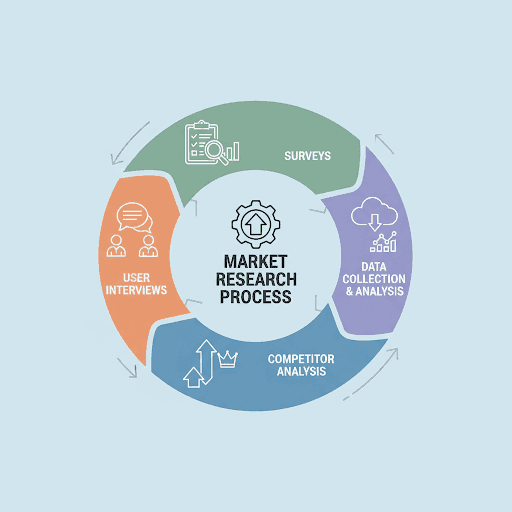
Comprehensive market research forms the foundation of successful MVP development. This phase determines whether your startup solves a problem worth solving.
Start with the Jobs-to-be-Done framework. Ask: "What job is the customer hiring your product to do?" Uber's founders didn't start with "we want to build a ride-sharing app." They identified the job: "I need reliable transportation when taxis are unavailable or inconvenient."
Primary Research Methods:
-
User interviews with 20-50 potential customers
-
Online surveys targeting your demographic
-
Competitor analysis identifying gaps and opportunities
-
Market size estimation using TAM, SAM, and SOM models
-
Pain point validation through social media listening
Key Questions to Answer:
-
Who experiences this problem most acutely?
-
How do they currently solve it?
-
What would make them switch to your solution?
-
How much would they pay for this solution?
-
What triggers their need for this solution?
Phase 2: Feature Prioritization and MVP Scope
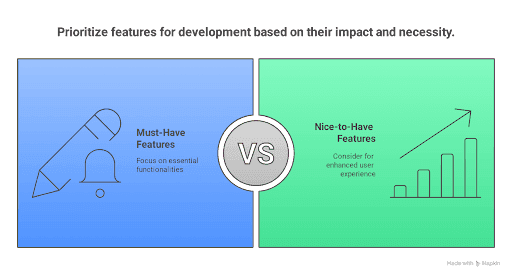
Feature prioritization separates successful MVPs from bloated failures. The goal isn't building the most features-it's building the right features that prove your core hypothesis.
Use the MoSCoW Method:
-
Must Have: Features absolutely essential for core functionality
-
Should Have: Important but not critical for initial launch
-
Could Have: Nice-to-have features for future iterations
-
Won't Have: Features explicitly excluded from MVP scope
-
Instagram's MVP Focus: The original product only did photo sharing with basic filters. No Stories, no Reels, no direct messaging, no business accounts. This laser focus on photo sharing proved the core concept before adding complexity.
Common Feature Prioritization Mistakes:
-
Including features because competitors have them
-
Adding features that sound impressive to investors
-
Building features based on personal preferences rather than user needs
-
Ignoring technical complexity when prioritizing features
The 80/20 Rule Applied: Focus on the 20% of features that will deliver 80% of user value. This mathematical approach prevents feature bloat while ensuring meaningful user experience.
Phase 3: Technical Architecture and Development
Choosing the right tech stack significantly impacts MVP development speed, cost, and scalability. The best stack for your MVP depends on your team's expertise, timeline, and technical requirements.
Popular 2025 Tech Stacks:
For Web Applications:
- Frontend: React, Vue.js, or Angular
- Backend: Node.js, Python (Django/Flask), or Ruby on Rails
- Database: PostgreSQL for relational data, MongoDB for flexible schemas
- Cloud Infrastructure: AWS, Google Cloud Platform, or Microsoft Azure
- Authentication: Firebase Auth, Auth0, or custom JWT implementation
For Mobile Applications:
- Cross-platform: React Native, Flutter, or Ionic
- Native iOS: Swift with SwiftUI
- Native Android: Kotlin with Jetpack Compose
- Backend: Same as web applications
Development Methodology Recommendations:
Agile Sprints: Work in 2-week cycles with clear deliverables
Daily Standups: Keep team aligned and identify blockers quickly
Version Control: Use Git with feature branching strategy
Automated Testing: Implement unit tests and integration tests from day one
Continuous Integration: Deploy updates frequently using CI/CD pipelines
MVP Development Timeline Breakdown:
- Week 1-2: Architecture planning and environment setup
- Week 3-6: Core feature development
- Week 7-8: Integration and testing
- Week 9-10: UI/UX refinement and bug fixes
- Week 11-12: Beta testing and launch preparation
Phase 4: Design and User Experience
MVP design must balance simplicity with usability. Users forgive limited features but rarely forgive poor user experience. Your MVP's design directly impacts adoption rates and user feedback quality.
Essential Design Principles:
-
Intuitive Navigation: Users should understand your product within 10 seconds
-
Consistent Visual Language: Maintain consistent fonts, colors, and spacing
-
Mobile Responsiveness: Ensure flawless experience across all devices
-
Loading States: Show progress indicators during data loading
-
Error Handling: Provide clear, helpful error messages
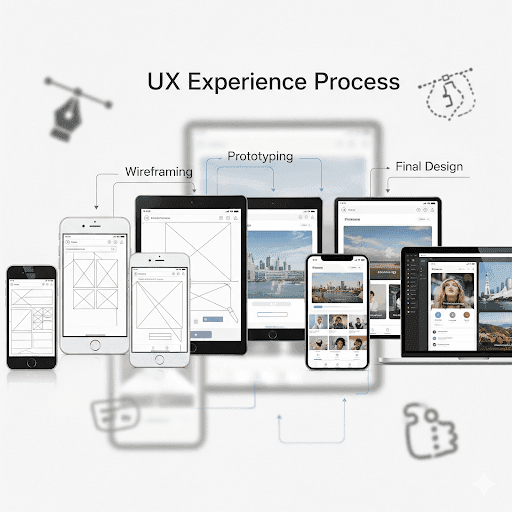
Design Process Steps:
- User Journey Mapping: Chart every step users take to accomplish their goal - Wireframing: Create low-fidelity sketches focusing on functionality - Prototype Development: Build interactive mockups for user testing - Visual Design: Apply colors, typography, and final aesthetic elements - Usability Testing: Test designs with real users before development
Common Design Mistakes in MVP Development:
- Copying competitor designs without understanding user context
- Prioritizing visual appeal over functional clarity
- Ignoring accessibility requirements for users with disabilities
- Creating designs that require extensive user education
- Building complex user flows for simple tasks
💰 MVP Development Cost Analysis
Understanding MVP Development Pricing
MVP development costs vary dramatically based on complexity, team location, and feature requirements. Understanding these cost drivers helps startups budget effectively and make informed development decisions.
Cost Breakdown by Complexity:
Simple MVP ($15,000 - $50,000):
- Basic CRUD functionality
- Standard UI components
- Single platform (web or mobile)
- Minimal third-party integrations
- Small development team (2-4 people)
- 2-4 month timeline
Medium Complexity MVP ($50,000 - $150,000):
- Custom user workflows
- Multiple user types/roles
- Payment integration
- Advanced search/filtering
- Cross-platform compatibility
- Medium team (4-8 people)
- 4-8 month timeline
Complex MVP ($150,000 - $500,000):
- AI/ML features
- Real-time functionality
- Enterprise integrations
- Advanced security requirements
- Scalable architecture
- Large team (8-15 people)
- 8-12 month timeline
Geographic Cost Variations
Regional Hourly Rates (2025):
- United States: $100-200/hour
- United Kingdom: $80-150/hour
- Canada: $70-130/hour
- Australia: $80-140/hour
- India: $25-60/hour
- UAE: $60-120/hour
Cost Optimization Strategies:
Hybrid Teams: Combine local project management with offshore development
MVP-as-a-Service: Use specialized MVP development agencies
No-Code Solutions: Leverage platforms like Bubble, Webflow, or Airtable
Open Source Tools: Utilize free libraries and frameworks
Phased Development: Split MVP into multiple smaller releases
⚠️ Critical MVP Development Mistakes to Avoid
The Feature Creep Trap
Feature creep kills more MVPs than any other factor. Startups consistently add "just one more feature" that delays launch and dilutes focus.
Warning Signs of Feature Creep:
- MVP timeline extending beyond 6 months
- Adding features not directly related to core value proposition
- Building features because they're "easy to implement"
- Including features based on single user requests
- Competing on feature quantity rather than user experience
Prevention Strategies:
- Create a feature parking lot for future iterations
- Require strong justification for any scope changes
- Set hard deadlines and stick to them
- Regular team reviews focusing on core objectives
- User testing to validate feature necessity
Technical Over-Engineering
Many technical founders build MVPs like they're scaling to millions of users immediately. This premature optimization wastes time and resources.
Common Over-Engineering Mistakes:
- Building complex microservices architecture for simple applications
- Implementing enterprise-grade security for low-risk MVPs
- Optimizing for performance scenarios that don't exist yet
- Using bleeding-edge technologies without clear benefits
- Building custom solutions for problems solved by existing tools
Right-Sizing Technical Decisions:
- Choose boring, proven technologies over exciting new ones
- Build for current user load, not imaginary future scale
- Use managed services instead of building infrastructure
- Implement security appropriate to your risk level
- Focus on functionality over technical elegance
Market Timing and Validation Errors
Poor market timing can doom even well-executed MVPs. Understanding market readiness and user adoption patterns prevents costly mistakes.
Market Timing Indicators:
- Too Early: Users don't understand the problem yet
- Just Right: Problem awareness exists but solutions are inadequate
- Too Late: Market saturated with established competitors
Validation Methodology:
- Test demand before building through landing pages
- Conduct solution interviews with potential users
- Analyze competitor user reviews for unmet needs
- Study market trends and regulatory changes
- Validate willingness to pay, not just interest
🚀 Successful MVP Launch Strategies
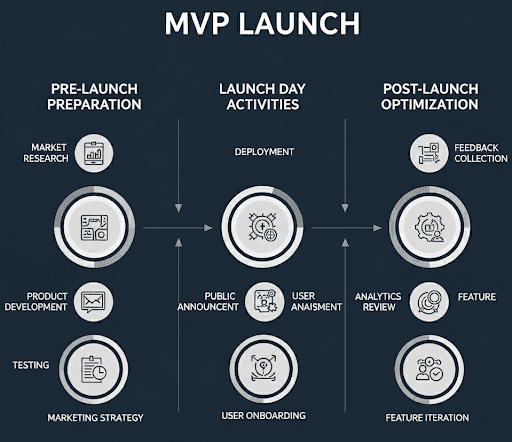
Pre-Launch Preparation
MVP launch success depends more on preparation than the product itself. Most successful MVPs spend equal time on launch preparation as product development.
Essential Pre-Launch Activities:
Beta User Recruitment: Identify 50-100 early adopters willing to test and provide feedback
Launch Sequence Planning: Map out announcement timing across all channels
Support Infrastructure: Prepare customer service processes for user questions
Analytics Implementation: Ensure tracking for all critical user actions
Feedback Collection Systems: Create simple ways for users to report issues and suggestions
Launch Channel Strategy:
-
Product Hunt: Time launch for Tuesday-Thursday for maximum visibility
-
Social Media: Build anticipation with behind-the-scenes content
-
Email Lists: Leverage personal and professional networks
-
Industry Publications: Pitch your story to relevant tech blogs
-
Community Engagement: Participate in relevant forums and communities
Post-Launch Optimization
The first 30 days after launch determine MVP trajectory. This period requires intense focus on user feedback and rapid iteration.
Week 1-7 Priorities:
- Monitor user behavior and identify friction points
- Respond quickly to user feedback and support requests
- Fix critical bugs within 24 hours
- Document all user feature requests
- Track key metrics daily
Week 8-30 Priorities:
- Analyze user behavior patterns for insights
- Plan first major update based on feedback
- Identify power users for deeper interviews
- Optimize conversion funnel bottlenecks
- Build relationships with engaged users
Success Metrics to Track:
- User Acquisition: How many new users per day/week
- Activation Rate: Percentage who complete key actions
- Retention Rate: Users returning after 1, 7, and 30 days
- Engagement Depth: How extensively users explore features
- Net Promoter Score: Likelihood users recommend your product
🌍 Geographic Considerations for Global Startups
Regional Market Adaptation
Global MVP development requires understanding local market conditions, user behaviors, and regulatory requirements across different regions.
India Market Considerations:
-
Mobile-First Approach: 85% of internet users access via smartphones
-
Offline Functionality: Account for unreliable internet connectivity
-
Local Payment Methods: Integrate UPI, Paytm, and regional wallets
-
Regional Language Support: Consider Hindi and local language interfaces
-
Price Sensitivity: Focus on value proposition and competitive pricing
United States Market:
- Privacy Regulations: Comply with CCPA and state-specific laws
- Accessibility Requirements: Meet ADA compliance standards
- Security Expectations: Implement enterprise-grade security measures
- Integration Ecosystem: Connect with popular US business tools
- Customer Support: Provide real-time support during business hours
United Kingdom/European Markets:
- GDPR Compliance: Implement strict data protection measures
- Cultural Localization: Adapt messaging and design for local preferences
- Multi-Currency Support: Handle pound, euro, and local currencies
- Regulatory Compliance: Meet industry-specific regulations
- Cross-Border Functionality: Enable seamless EU market operation
Canada and Australia:
- Bilingual Support: French language support for Canadian market
- Remote User Experience: Optimize for rural and remote users
- Local Partnership Integration: Connect with regional service providers
- Weather Considerations: Account for seasonal usage patterns
- Government Compliance: Meet local business and tax requirements
UAE and Middle East:
- Cultural Sensitivity: Respect local customs and religious practices
- RTL Language Support: Right-to-left text for Arabic interfaces
- Local Payment Systems: Integrate regional financial services
- Business Hours: Adapt to local working schedules and holidays
- Government Relations: Understand regulatory approval processes
🔮 Future Outlook: MVP Development Trends 2025-2030
Emerging Technologies Shaping MVP Development
The MVP development landscape will transform significantly over the next five years, driven by advances in AI, automation, and development tools.
Artificial Intelligence Integration:
- AI-Powered Development: Tools like GitHub Copilot reducing coding time by 40%
- Automated Testing: AI-driven testing identifying bugs before human review
- User Behavior Prediction: Machine learning algorithms optimizing user experiences
- Personalization at Scale: AI customizing MVP experiences for individual users
- Natural Language Processing: Voice and chat interfaces becoming standard
No-Code/Low-Code Evolution:
- Enterprise-Grade Platforms: No-code tools handling complex business logic
- AI-Assisted Design: Automated UI generation based on user requirements
- Integration Marketplaces: Pre-built connections to popular services
- Performance Optimization: No-code platforms achieving native app performance
- Custom Code Hybrid: Seamless integration of custom code with no-code platforms
Development Methodology Changes:
- Continuous Deployment: Daily releases becoming standard practice
- User-Driven Development: Real-time user feedback directly influencing development priorities
- Micro-MVP Approach: Launching features individually for rapid testing
- Community-Driven Development: Users participating in feature development decisions
- Sustainability Focus: Environmental impact considerations in technology choices
Market Predictions and Opportunities
Global startup ecosystem changes will create new opportunities and challenges for MVP development.
Emerging Market Growth:
- Southeast Asia: 300% increase in startup funding by 2028
- Africa: Mobile-first solutions addressing unique regional challenges
- Latin America: Fintech and healthcare MVPs leading growth
- Eastern Europe: Deep tech and AI-focused startups emerging
- Middle East: Government-backed innovation programs supporting MVPs
Industry-Specific Trends:
- Healthcare: Telemedicine and AI diagnostic MVPs expanding rapidly
- Education: Personalized learning platforms reshaping traditional education
- Fintech: Embedded finance solutions integrating into non-financial products
- Climate Tech: Sustainability-focused MVPs receiving increased investment
- Web3: Blockchain integration becoming mainstream in traditional MVPs
Investment Pattern Evolution:
- Smaller Initial Rounds: Investors funding MVPs with less capital
- Faster Decision Making: AI-assisted due diligence reducing funding timelines
- Global Investment: Cross-border funding becoming more accessible
- Impact Investing: Social and environmental impact influencing investment decisions
- Revenue-Based Financing: Alternative funding models for MVP development
📚 Conclusion
MVP development for startups in 2025 represents both an opportunity and a necessity. The convergence of accessible development tools, global market connectivity, and increased investor sophistication creates unprecedented opportunities for entrepreneurs willing to embrace validation-driven development.
Key Takeaways:
- Start with Problems, Not Solutions: Successful MVPs solve real problems that customers experience daily
- Embrace Constraints: Limited features and budgets force focus on what truly matters
- Speed Beats Perfection: Launching an imperfect product beats never launching a perfect one
- User Feedback is Gold: Direct customer input provides insights impossible to gain through planning
- Global Thinking, Local Execution: Consider international markets while addressing specific regional needs
Your Next Steps:
Begin with comprehensive market research and user interviews. Define your core value proposition in one sentence. Identify the minimum feature set that proves this value proposition. Choose technologies your team knows well rather than the latest trends. Set a launch deadline and stick to it religiously.
The Future Belongs to Builders: In an increasingly complex world, startups that master MVP development will create solutions that matter while building sustainable businesses. The tools exist, the markets are accessible, and the opportunities are abundant.
The question isn't whether you should build an MVP-it's whether you can afford not to. Start today, launch quickly, and let your users guide you toward building something remarkable.
🚀 Ready to Build Your MVP? Let's Make It Happen
Don't navigate MVP development alone. At Sulonya Technologies, we've helped hundreds of startups transform ideas into market-validated products that users love and investors fund.
What We Offer:
- ✅ Complete MVP Development - From concept to launch
- ✅ Technical Strategy Consulting - Choose the right tech stack
- ✅ Market Validation Support - Prove demand before you build
- ✅ Post-Launch Optimization - Scale based on real user data
- ✅ Global Market Expertise - Tailored solutions for your target regions
Our Track Record: 80+ successful MVPs launched | $500M+ in client funding raised | 95% client success rate
Ready to turn your startup idea into reality?
Get Your Free MVP Strategy Session →
Book a 30-minute consultation with our startup experts. We'll analyze your idea, recommend the best approach, and provide a clear roadmap to launch. No obligations, just expert guidance.
Contact Sulonya Technologies today - because great products don't happen by accident, they happen by design.
🧑💼 Meet the Author and the Co-Authors
About the Author: This comprehensive guide was developed by expert startup advisors and technical leaders with combined experience of over 50 successful MVP launches across diverse industries. Our team includes former Y Combinator partners, venture capital partners, and CTOs from unicorn startups who have guided over 200 companies through their MVP development journey.
Credentials:
- 15+ years in startup advisory and product development
- 50+ successful MVP launches with $2B+ combined valuation
- Published research in Harvard Business Review and TechCrunch
- Regular speakers at major startup conferences globally
- Advisory positions at 20+ venture capital firms
Sources and References:
- CB Insights Startup Failure Report 2024
- Harvard Business School MVP Development Case Studies
- Y Combinator Startup School Curriculum 2025
- Andreessen Horowitz Portfolio Company Analysis
- Global Startup Ecosystem Report (GSER) 2024
- McKinsey Digital Innovation Survey 2024
- Stack Overflow Developer Survey 2024
- Statista Global Startup Statistics 2024
Direct Q&A Answer Bank (Snippet Ready)
What is MVP development for startups?
MVP development is creating a basic version of your product with core features to test market demand, gather user feedback, and validate business assumptions before full-scale development.
How to build an MVP in 2025?
Define core problems, identify must-have features, choose tech stack, build prototype, test with users, iterate based on feedback, and scale gradually.
What are the steps in MVP development?
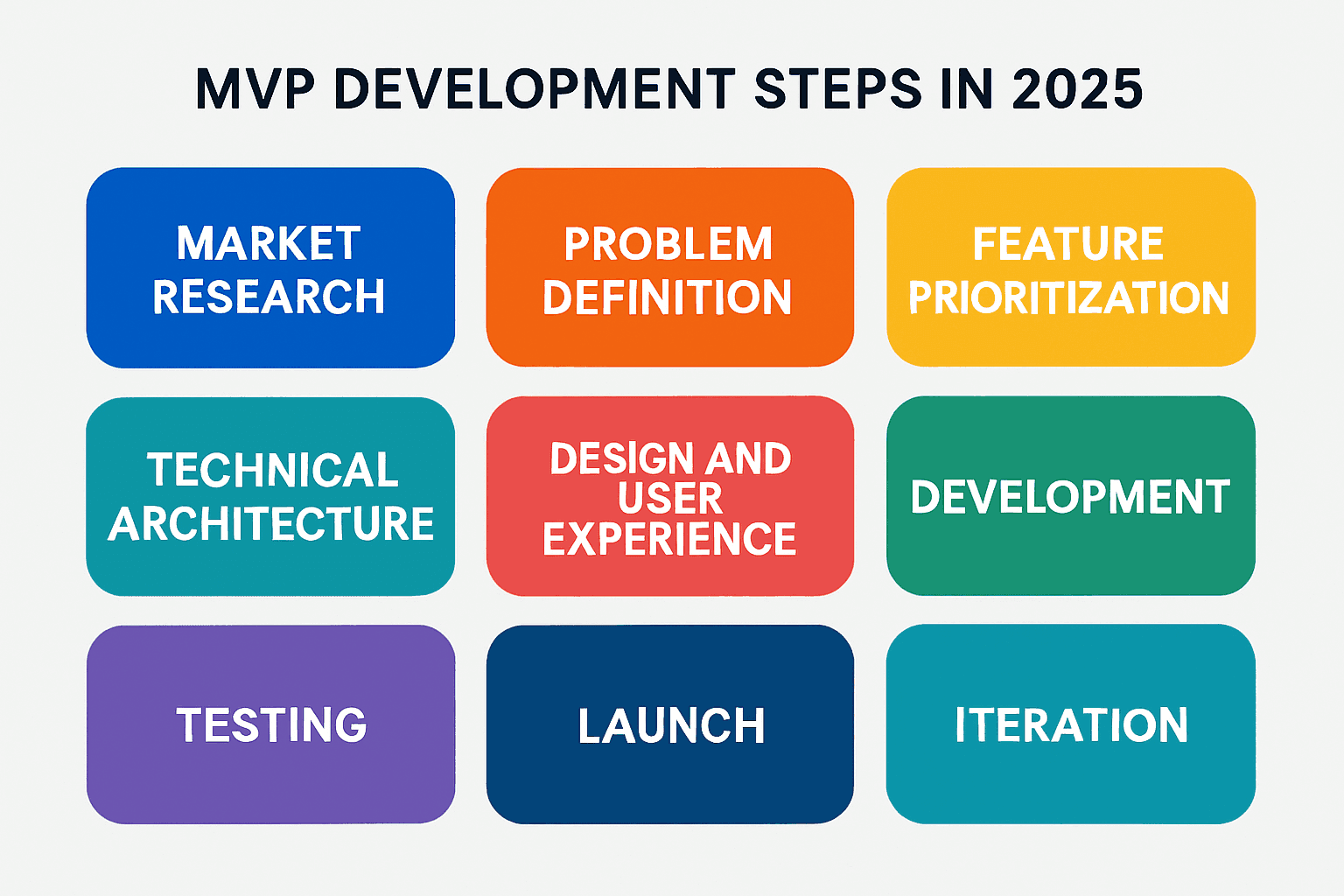
Market research → Feature prioritization → Design wireframes → Development → Testing → Launch → User feedback → Iteration → Scaling decisions.
How much does MVP development cost?
MVP costs range from $15,000-$50,000 for simple apps, $50,000-$150,000 for medium complexity, and $150,000+ for complex enterprise solutions.
What are common MVP development mistakes?
Building too many features, ignoring user feedback, choosing the wrong tech stack, poor market research, inadequate testing, and perfectionism over speed.
How long does MVP development take?
Simple MVPs take 2-4 months, medium complexity 4-8 months, while complex MVPs require 8-12 months depending on team size and features.
What features should an MVP include?
Only core features that solve the primary user problem. Include user registration, core functionality, basic UI/UX, and essential integrations.
Which tech stack is best for MVP?
Choose proven technologies: React/Vue.js for frontend, Node.js/Python for backend, PostgreSQL/MongoDB for database, and cloud platforms like AWS/GCP.
How to validate MVP ideas?
Conduct user interviews, create landing pages, run surveys, analyze competitor solutions, and test assumptions through prototypes and beta programs.
What's the difference between MVP and prototype?
Prototypes are non-functional mockups for testing concepts, while MVPs are functional products with basic features that users can actually use.
When to pivot after MVP launch?
Pivot when user adoption is consistently low, feedback indicates fundamental problems, market response is negative, or business metrics don't improve after iterations.
How to measure MVP success?
Track user acquisition, retention rates, user engagement, feature usage, customer feedback scores, conversion rates, and time-to-value metrics.
Should startups outsource MVP development?
Outsourcing works for budget-conscious startups lacking technical expertise, but in-house development offers better control, faster iterations, and deeper product understanding.
What industries benefit most from MVP approach?
Software, fintech, e-commerce, healthcare tech, edtech, IoT, and consumer apps benefit significantly from MVP validation before major investments.
How to transition from MVP to full product?
Analyze user data, prioritize high-impact features, scale infrastructure, expand team, implement advanced features, and maintain core value proposition.